Distance: 8.25 miles round trip
Elevation: 14,270 ft (Grays) & 14,267 ft (Torreys)
Elevation Gain: 3,200 ft
Date Hiked: 23 August, 2006 (some photos from 2010)
Dogs: Off Leash
 View from the summit of Grays Peak (2010)
I lost my 14er virginity on Grays Peak and even dropped trough on the summit in celebration, but I get ahead of myself. Grays has been the site of many deflowerings because it is an easy Class I (walk up) ascent and is close to Denver. If you tend towards exhibitionism or don't mind sharing your panting climaxes with 200 or so of your fellow adventurers then by all means join the herd and head to Grays and its sister Torreys for your first ascent.
 A photo of the route up Grays and Torreys from the 14ers.com website.
I was fortunate in that I took a day off of work back in August of 2006 and so I only had to smoke the proverbial cigarette with 7 other people. I learned a thing or two about mountaineering that day and fell in love with 360° views.
 The stream near the trailhead (2006)
The trailhead to Grays and Torreys Peaks is up Steven Gulch Rd off I-70 near Bakersville. Bring a 4WD because the road is filled with SUV consuming potholes. The parking lot is also small, so join the rest of the smart ones and get there before 7am, which brings me to my first mountaineering lesson: Start early. In Colorado, most summer days are filled with afternoon thunderstorms. You really need to consider being off the mountain before 1 PM. If the weather gods are kind, you'll have clear skies and can linger on the summit but don't plan on it. Start out too late, and you will be dodging lighting bolts as you tumble head over heels down the mountain.
 The sparse landscape and high valley walls (2010)
The route up these two mountains starts off crossing a small creek and then heads up a broad valley bordered on each side by long ridges. There is not much to see here but some low willows and piles of talus. The route continues this way for quite a while before it finally starts to climb upwards over and around series of large shoulders. It is here that Torreys comes into view since it lies directly at the end of the valley.
 The terrain from the end of the valley (2006)
It wasn't until I was past these bumps and entered the many switchbacks that head up the face of Grays did I really consider myself on the mountain. From this point on it is back and forth, back and forth, inching ever higher. Grays is a gray, dreary, monotonous experience. The only view is back down the valley. It is however, an accessible experience for those who want a taste of altitude.
 Torreys comes into view at the end of the valley. The route is going to ascend the large pile to the left (2006).
The summit came surprisingly fast and I was suddenly surrounded by views for what seemed to me at the time to be little effort. I immediately had to put on the several layers I fortunately packed in my bag. This was lesson number two: It really is cold Virginia, up there on the craggy bits. Plan for it by bringing layers.
 On the slope of Grays, looking back down the valley (2010)
We ate lunch on the summit and then I waited in line for a clear spot for a bio break. My companions were all the way back down to the saddle (at 13,707 ft) between Grays and Torreys by the time the honeymooners near me were done taking pictures and moved off so I could have 30 seconds of privacy. When I was done, I raced down and started up Torreys way too fast as I tried to catch up with my friends. Half way up Torreys, the altitude hit me like a ton of bricks. My vision became blurred and my breathing erratic. Here was lesson three: Don't eat if there is more elevation gain in the schedule. All that blood and oxygen needed to keep your brain functioning goes right to your stomach and is not available for other things like foot placement and lung function. Note honeymooners, the same thing happens during other activities.
 Looking over to Torreys. Note we are not alone on the mountain (2010)
The trail up Torreys is a vertical calf-burner with limited switchbacks. It is only 560 feet of elevation gain to the summit, but is slightly more difficult because of the terrain, and the fact you cover this in only 0.5 miles. Anytime you can bag more than one peak in a day, is a good day in the mountains, however, and we were lucky that the weather held and we did not have to head down.
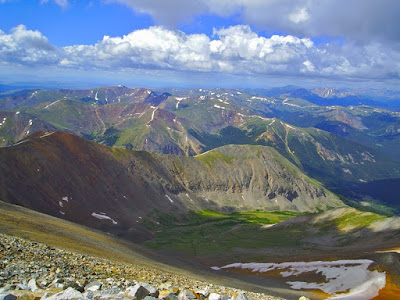 Another view near the summit (2010)
The route down from Torreys is straight forward. Once back down to the saddle there is a spur trail that connects with the trail coming up Grays so it is a simple route. I experienced my fourth lesson at this point of the trail: Going down is not nearly as much fun as going up. Not only is it harder on the legs, but the thrill is gone and there is nothing but the parking lot as motivation. Mountain climbing is the only sport that celebrates at the half way mark. In the case of more dangerous routes, this trend is amusing because getting down is often more life threatening than getting up. I am not in that league, however, so it is more ennui that is the biggest threat to my existence.
 My friends on the saddle between Grays and Torreys (Lynn Johnson, 2006)
The slog back down the valley was particularly tedious and I was low on water. Here was my final lesson of the day: On bare mountain slopes there is no water and you have to carry everything you need, which is no fun because water is very heavy.
 There is one denizen of the mountain who lives there year round (2006)
As a parting shot (pun intended), I would like to give a note of thanks to the photographers I have so shamelessly stolen from to make this post possible. I climbed these peaks two years before I started this blog and did not bring a camera with me. None of my friends on my ascent took a full trail profile, so I have not been able to blog this popular trail. Recently, however another friend, Sarah Meyer, reached the summit of Grays and took a bunch of pictures that have finally enabled me to share my impressions with my fellow hikers. Her pictures are labeled 2010. The others are given credit if I know who took them, otherwise they are just labeled 2006.
 The Sugarbowl wildflower has many names including Hairy Clematis, Sugar Bowls, Douglas' Clematis, and the Leather Flower.
 A view from one of the many overlooks on the Spruce Mountain Trail in Douglas County
 The parking lot
 Example of the trail signage. This is the junction with the Spruce Meadow Trail where I took a left.
 The Oak Shortcut Trail
 A screen shot of the trail system from the Douglas County web site.
 A view to the east. That open grassland is perfect for horse back riding.
 A typical trail segment through the early switchbacks
 Picnickers on one of the many spots on Greenland Overlook
 Looking south at the rest of the mesa from the Greenland Overlook
 Paddock's Point
 The view of Eagle Mountain from Paddock's Point
 A typical trail segment on the mesa. There is a family standing on the rock outcropping in the distance.
 A view of ranch land from the rock outcropping in the picture above
 Another view of the sandstone cliffs. This trail reminds me a lot of Castlewood Canyon State Park.
 A typical trail segment on the western side of the loop
 A new resident to my condo complex, a young Red Fox (Vulpes vulpes)
 At 6:00 am this Fox was ready for bed, she finally curled up and started yawning.
 I kept shamelessly stalking this poor mother who would dart around pine trees to avoid me. The Foxes in Boulder are far more used to people and will even sleep on the hood of peoples cars.
 View from the summit of Grays Peak (2010)
 A photo of the route up Grays and Torreys from the 14ers.com website.
 The stream near the trailhead (2006)
 The sparse landscape and high valley walls (2010)
 The terrain from the end of the valley (2006)
 Torreys comes into view at the end of the valley. The route is going to ascend the large pile to the left (2006).
 On the slope of Grays, looking back down the valley (2010)
 Looking over to Torreys. Note we are not alone on the mountain (2010)
 Another view near the summit (2010)
 My friends on the saddle between Grays and Torreys (Lynn Johnson, 2006)
 There is one denizen of the mountain who lives there year round (2006)


