Thursday, May 3, 2012

Snowy Egret

The Snowy Egret (Egretta thula) with its lovely white plumage and expressive eyes
The Snowy Egret (Egretta thula) is a showy bird that was once almost hunted to extinction so that fashionable ladies on the East Coast could have a feather in their hat.  Fortunately, enlightened conservationists in the early 1900's stopped the slaughter around the same time that National Parks were coming into existence.  It can identified by its yellow feet and yellow patch around its eyes.  At  24 inches is small by heron standards being dwarfed by the Great Blue Heron, which also calls the state home. 

Lunging forward for the kill
The Snowy Egret feeds on fish, frogs, and crustaceans in shallow ponds and swampy areas.  They actually stalk their prey and as one of the pictures in this post will attest, their long bill looks like a jet fighter about to swoop in for the kill.  Woe to the frog negligently croaking within sight of the Snowy Egret.


I caught site of this specimen along Dry Creek in Westminster while out for a bike ride.  Since it was the first one I had seen in the state, I almost crashed into a large Cottonwood in my haste to dismount and lunge, dare I say it, Snowy Egret-like after the shot.  I stood around for quite a bit while it gracefully strolled around in the mud, only to reach forward in staccato bursts after some tasty morsel. 

Gee, no dinosaur like qualities here!  Beware the bill!

Tuesday, May 1, 2012

Arches National Park: Park Ave

Distance: 2 miles round trip
Elevation: 4,680 ft - 5,000 ft
Elevation Gain: 320 ft
Date Hiked: 25 April 2012
Bathroom at Trailhead: No
Water at Trailhead: No
Dogs: Not allowed

The Park Ave Trail from the Park Ave parking lot.  The thin like rock formations are called fins.  You will see a lot more of them as this sequence continues.
Park Avenue is one of the loveliest hikes in the Arches National Park.  The towering fins and megalithic rocks that line the sides of the trail surround the hiker with their phenomenal majesty.  I would learn later that fins are the key to arch development,  but on this, my first hike in the park, they seemed so very strange compared to the canyons and volcanic remnants I am used to seeing.

The trail from Courthouse Towers begins on the other side of the road and heads down a path bordered by rocks.
The passage of many touristas has removed the dust from the route to reveal the smooth stone beneath.
The trail is named Park Avenue because the towering walls reminded early explorers of the skyscrapers in New York City.  Instead of high-end stores, bustling people, and continuous cacophony, I was greeted by shrubbery in bloom and a pleasantly cool breeze blowing down the canyon.  I saw only a couple of hikers. 

On the sides of the route you can see the many layers of sandstone the water cut through.
The route follows the barren stream bed and is easy to follow.
You can hike this trail as a shuttle for a one mile journey or do it as an out and back for a two mile trip.  I recommend the latter because the views are totally different each way.  If you start at the first trailhead as you enter the park, you'll hike down first and up last.  If you start at the Courthouse Towers viewpoint you will do the opposite.  This was the route I chose so that I was hiking down hill on the last pitch.

Our destination is the slot between the rocks straight ahead
Stone steps lead up to the parking lot.  This section is the steepest.
What I like best about this hike was that the route followed an old stream bed and the evidence of flowing water was everywhere.  The soft rock had been carved into curvaceous patterns in the center while the many layers of sediment along the edges were jagged and exposed.  The overall affect was poignant.  Water was everywhere and nowhere.

Standing at the viewpoint looking at the fins
At a distance, the skeleton of a Utah Juniper dwarfs the megalithic rocks behind it.
I hiked this trail around 6pm in the evening after a long drive from Denver.  It is was short and close to the entrance and was a great way to get oriented to the park as well as stretch my travel weary legs.

Approaching the trailhead, the hiker gets a glimpse of the rock formations deeper into the park.
The rock formation on the left is called the 3 Gossips.  The rocks in the foreground are the side of cars.

Monday, April 30, 2012

Arches National Park: Trip Preview

Driving into the heart of Arches National Park
I went on the road last week to hike every trail in Arches National Park in Utah.  This fulfilled a lifelong bucket list item for me. 

What I found was that Arches was more than hikes to cool geological features.  It was really a journey through an amazing and vibrant landscape filled with chattering birds, amazing wildflowers, wild weather, and  those cool geological features.  Of course, the geology is a journey itself, back into deep time when the "lizards" where a lot bigger than today and this part of the world was the shoreline of giant inland sea. For most people though a visit to the park is really a scenic drive with lots of short hikes.   As such a visit to Arches will also be a journey taken with many of your fellow humans.  There are a few stops where solitude can be found, but not many. 

Blooming cactus
Over the next sequence of posts, I will blog each trail to give you a feel for the park and toss in information about some of the unique flora and fauna you will experience if you ever make the journey yourself. You will be able to find links to each of these posts in a special index found elsewhere on this blog and also in the list below (updated as they appear):


Saturday, April 21, 2012

Hogback

Distance: 3 miles round trip
Elevation: 5,560 ft - 6,393 ft
Elevation Gain: 880 ft
Bathroom at Trailhead: No
Dogs:  Not allowed at all
Date Hiked: 1 April 2012
Tags: #Boulder, #osmp, #hiking, #coloradooutdoors

Heading up to the Hogback on the Hogback Trail north of Boulder
The Hogback lollypop trail, just north of Boulder, is an unassuming jaunt across open grassland and up the steep slope of the first foothill of the Front Range.  Its name is derived from the large outcropping of rocks known as the Hogback, that are the apex of the route.  Since dogs are not allowed on this trail at all, this is only the second time I have hiked it.  If you don't care about Fido, however, this trail has sufficient elevation gain to classify as great shoulder season training hike.  It is rarely impassible but its exposure and lack of shade would make for a toasty outing in summer.

The Hogback Trail starts at the Foothills Trailhead, just north of Boulder
The Trailhead.  That is a tunnel under Hwy 36 a 100 yards in the distance
The winding first 0.5 miles of the trail 
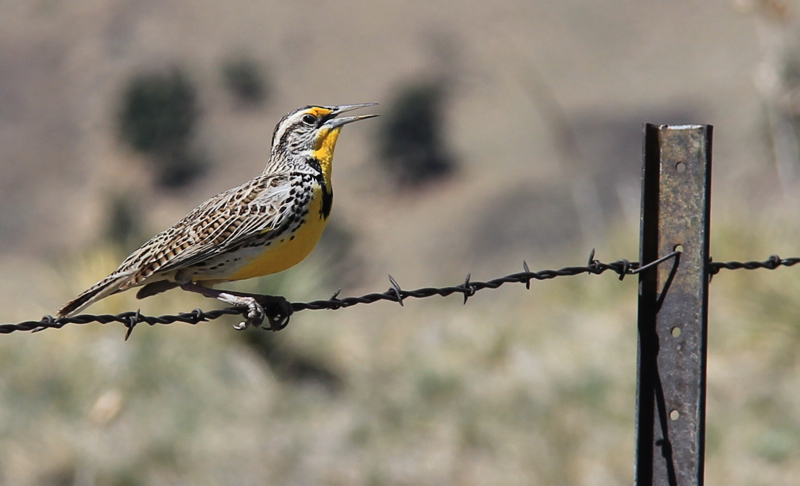
The bright yellow breast and distinctive song of the Meadowlark accompany the hiker on the Hogback Trail.
The initial part of the trail traverses a small valley filled with Prairie Dogs and Meadowlarks, who brazenly yoddle from every fence post and stalk of Yucca.  At 0.5 miles the trail intersects and merges with the Foothills Trail and then splits off at 0.65 miles to the Hogback Trail.  A short distance beyond this is another T-junction that represents both sides of the Hogback Loop.  I prefer to ascend via the left.  From this vantage, there are lovely views of the Flatirons and the ascent to the Hogback itself traverses a hidden plateau that for at least a few minutes makes you forget you are near the city.

The intersection of the Foothills Trail and the Hogback Loop
The junction of the loop itself.  Take the left fork for a harder and more scenic climb.
Looking out onto the plains and back down on the parking lot 600 feet below
The steepest section of trail has improved stairs.
It is 1.5 miles to the middle of the Hogback formation itself.  The trail stays below the edge, so if you want views you'll have to do a little rock scrambling.  Just be on the lookout for Rattlesnakes lounging in the nooks and crannies.

Looking up at the Hogback from the south
This brief but pleasant segment winds through rocks and Ponderosa Pine
An exposed section of rock below the summit
Walking below the summit of the Hogback ridge
For you geology buffs, a Hogback formation gets its name from its resemblance to the bristled spines of a wild hog.  These formations occur where erosion has revealed the sharp rocks of a tilted or uplifted rock formation.   Hogbacks can be seen up and down the Front Range.  The most famous one to the south, Dinosaur Ridge, has the preserved footprints of Sauropod and carnivorous dinosaurs.

Still on the ridge but starting to descend
Looking down the decent
Looking north from below the Hogback
This herd of Mule Deer walked right up to me
While the Hogback trail will not attract tourists from far and wide, it is still a pleasant outing, particularly if you live in Boulder and are sick of the trails around Chautauqua.  I do suggest checking it out...just leave Fido at home.

North Rock Creek Snowshoe

Distance: 4 miles round trip Elevation: 9,180 ft to 9,780 ft Elevation Gain: 600 ft Dogs: Off leash until the wilderness boundary North...